___________________________________________________________________________________
Are you looking for a larger-than-life experience of television? A 75-inch TV is the perfect way to create a home theater experience that can bring your favorite movies and shows to life. But before you make a purchase of 75-inch TV, it is important to consider its dimensions which ensure its perfect fit in your living room.
In this article, we will discuss the average dimensions of a 75-inch TV, as well as other important considerations before buying a masterpiece like 75-inch TV.

Comprehensive Guide to TV Sizes
The size of a TV plays a vital role when it comes to selecting a new one. The right TV size can greatly enhance your viewing pleasure and create an endless experience of joy. TVs are available in different ranges of sizes, each offering its own advantages.
Smaller sizes, such as 32 inches or smaller, are ideal to enjoy in compact spaces like kitchens or bedrooms. They can be mounted on a wall or placed on a countertop conveniently. Medium-sized TVs, ranging from 40 to 55 inches, offer a balance between screen real estate and practicality, making them suitable for average-sized living rooms. Nowadays, to have larger than life experience of movies or to enjoy sports and gaming to another level, the popularity of large–sized TV like 75 inches TV has increased.
What are Dimensions of Television?
The dimensions of a TV refer to the physical measurements of the television set. These dimensions typically include the width, height, and depth (or thickness) of the TV.
Width
The width of a TV represents the horizontal measurement from one side of the TV to the other. It indicates how wide the TV is when viewed from the front.
Height
The height of a TV represents the vertical measurement from the top to the bottom of the TV. It shows the vertical size of the TV when viewed from the front.
Depth or Thickness
The depth or thickness measurement of a TV represents the distance between its front and back surfaces. It serves as an indicator of the TV’s overall slimness or thickness when observed from a side perspective.
Importance of Considering TV Dimensions
Selecting a TV involves more than just considering its features and picture quality. The dimensions of a TV play a crucial role in ensuring your comfort and satisfying viewing experience. From fitting the TV into your desired space to maintaining a balanced room layout, considering the dimensions is essential.
The dimensions of a TV are important to consider for several reasons:
Space Requirements
TV dimensions help determine if the TV will fit in your desired location. Knowing TV dimensions is essential to ensure it fits in the space you plan to put it. This applies whether you mount it on a wall, place it on a TV stand, or fit it into an entertainment center.
Viewing Distance
The size of the TV is closely tied to the optimal viewing distance. Different TV sizes are recommended for specific viewing distances to ensure a comfortable and immersive experience. By considering the dimensions, you can select a TV size that matches your viewing distance, preventing eye strain or discomfort.
Room Aesthetics
TV dimensions play a role in maintaining a balanced and visually appealing room layout. Optimal viewing experience relies on choosing a TV size that suits your space. A small TV in a large room may appear dwarfed, while a large TV in a small space can overwhelm.
Therefore, it’s crucial to select a TV that fits just right to ensure an immersive and satisfying viewing experience. By considering the dimensions, you can choose a TV size that harmonizes with the overall aesthetics of your room.
Accessibility and Practicality
TV dimensions also influence the practicality of installation and usage. A TV that is too large or heavy might be challenging to install or move around. Additionally, considering the dimensions can help ensure that the TV is compatible with existing TV stands, wall mounts, or other accessories.
Viewing Experience
Finally, the dimensions of a TV impact your overall viewing experience. A larger TV provides a more immersive and engaging visual experience, while a smaller TV might be more suitable for casual or intimate viewing. By considering the dimensions, you can select a TV size that aligns with your preferences and desired level of immersion.
Average Dimensions of 75-inch TV
Talking about the dimensions of a 75-inch TV, it’s important to note that the given measurements are approximate. Different manufacturers may have variations in design, which can lead to slight differences in the actual dimensions of the TV.
These measurements typically refer to the TV itself and do not include any additional stands or mounting brackets. It’s quite necessary to keep this in mind in order to get precise measurements. Also, it is advisable to refer to the specific model’s manufacturer specifications.
Dimensions of 75-inch TV in Different Units
Having the dimensions of a 75-inch TV in multiple units allows you to understand its size and fit within different measurement systems. This versatility can be beneficial when comparing the TV’s dimensions to the available space in your room, especially if you’re more familiar with one unit over another.
It provides flexibility in evaluating if the TV will properly fit on a TV stand, wall mount, or within a specific entertainment center setup.
In Inches
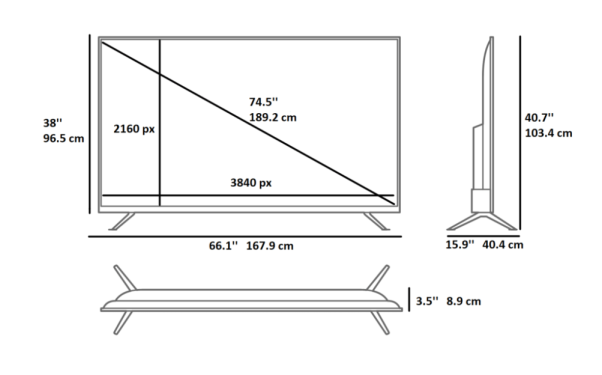
Width: Approximately 66 inches
Height: Approximately 37 to 38 inches
Depth/Thickness: Approximately 2 to 3 inches
In Feet
Width: Approximately 5.5 feet
Height: Approximately 3.08 feet
Depth/Thickness: Approximately 0.17 to 0.25 feet
In Centimeters
Width: Approximately 167.6 centimeters
Height: Approximately 94 centimeters
Depth/Thickness: Approximately 5 to 7.6 centimeters
In Millimeters
Width: Approximately 1676 millimeters
Height: Approximately 940 millimeters
Depth/Thickness: Approximately 50 to 76 millimeters
Diagonal Measurement of 75-inch TV
The diagonal measurement is the distance from one corner of the screen to the opposite corner, passing through the center of the screen. It provides a way to quantify the overall size or screen area of a TV, regardless of its width or height.
The diagonal measurement is commonly expressed in inches or centimeters and is a standard specification used to describe the size of TVs and monitors.
Calculating Diagonal Measurement with Pythagorean Theorem
The Pythagorean Theorem can be used to calculate the diagonal measurement of a 75-inch TV. According to the theorem, the square of the diagonal (hypotenuse) is equal to the sum of the squares of the other two sides in a right-angled triangle. In the case of a TV, the width and height act as the two sides of the triangle, and the diagonal is the hypotenuse.
To calculate the diagonal measurement of a 75-inch TV, you can use the following formula:
Diagonal = √ (Width2 + Height2)
For a 75-inch TV, assuming the width and height are proportional to the standard aspect ratio, the diagonal measurement would be approximately 75 inches.
Optimal Viewing Distance from 75-inch TV
The optimal viewing distance for a 75-inch TV depends on various factors, including personal preference and the resolution of the TV. However, there are some general guidelines to consider:
High Definition (HD) TVs
For a 75-inch HD TV (1080p resolution), the recommended viewing distance is approximately 8 to 12.5 feet (2.4 to 3.8 meters). At this distance, you can enjoy a sharp and detailed image without perceiving individual pixels.
4K Ultra HD TVs
For a 75-inch 4K Ultra HD TV (2160p resolution), you can sit closer to the screen without noticing pixelation. A suggested viewing distance for 4K resolution is approximately 6 to 9 feet (1.8 to 2.7 meters). Sitting closer allows you to fully appreciate the higher pixel density and enjoy a more immersive viewing experience.
What should be the Placement Height of the 75-inch TV?
Placement Height
Placement height refers to the specific vertical positioning or elevation at which a TV is positioned or mounted within a viewing area.
Calculation of the Placement Height
The Society of Motion Picture and Television Engineers (SMPTE) provides guidelines and formulas for calculating the optimal TV mounting height based on factors like viewing distance, reclining angle, and eye level. It can be expressed as below:
TV mounting height = tan (viewing angle) x distance + eye-level height
For an average viewing distance of 10 feet, the formula suggests fixing a 75-inch TV at a height of 68 inches from the floor up to the center of the TV.
Factors Affecting Placement Height
The placement height of a 75-inch TV depends on various factors, including the viewing environment and personal preference. However, there are some general guidelines to consider when determining the optimal placement height:
Eye Level
The ideal placement height for a TV is typically at or slightly below eye level when seated in your primary viewing position. This ensures a comfortable and natural viewing experience without straining your neck or eyes. When seated, your eye level should align with the center of the TV screen.
Mounting Options
If you choose to mount the TV on a wall, the height will be determined by the wall mount’s positioning and the desired eye level. Ensure that the center of the TV aligns with your eye level while seated. It’s recommended to consult the manufacturer’s guidelines for the specific wall mount to ensure proper installation and adjustment options.
Stand or Furniture Placement
If using a TV stand or furniture to support the TV, consider the height of the furniture and its compatibility with the TV’s dimensions. The TV should be placed on a stable surface that provides proper support and ensures a comfortable viewing position.
Room Environment
Take into account the layout and seating arrangement in the room. Ensure that the TV placement allows for unobstructed viewing from various seating positions without straining the neck or requiring uncomfortable viewing angles.
Popular 75-Inch TVs and their Dimensions
When it comes to 75-inch TVs, different brands and models can have variations in dimensions. It’s important to consider the specific measurements of a TV before making a purchase. Here are the dimensions of some popular 75-inch TVs from various brands.
Sr.No | 75-inch TV from Popular Brands | Dimensions |
1 | Samsung QN75Q80T | Approximately 66.3″ W x 37.7″ H x 2.4″ D |
2 | LG OLED77C1PUB | Approximately 66.1″ W x 37.9″ H x 1.8″ D |
3 | Sony XBR-75X950H | Approximately 66″ W x 37.8″ H x 2.9″ D |
4 | TCL 75R635 | Approximately 65.9″ W x 37.7″ H x 3.0″ D |
5 | Vizio P75QX-H1 | Approximately 66.2″ W x 37.8″ H x 3.1″ D |
Factors Affecting the Dimensions
Factors that can influence the actual size of a 75-inch TV include bezel thickness and design choices made by manufacturers. The bezel refers to the frame surrounding the TV screen. Here’s the detail of these two factors:
Bezel Thickness
The thickness of the bezel can be changed with different TV models, brands, or manufacturers. TV having a thinner bezel allows for a larger screen-to-body ratio, resulting in a sleeker overall appearance.
On the other hand, a thicker bezel can increase the overall dimensions of the TV as it extends beyond the screen edges.
Design Choices
Manufacturers may choose different design elements that can affect the dimensions of a 75-inch TV. Some designs may feature a minimalistic bezel, creating a borderless look, while others may choose wider or more prominent bezels for aesthetic purposes.
FAQs (Frequently Asked Questions)
Q: What are the average dimensions of a 75-inch TV?
A: The average dimensions of a 75-inch TV are approximately 65 inches wide, 38 inches tall, and 2 inches thick.
Q: How important is it to consider the dimensions when purchasing a 75-inch TV?
A: Considering the dimensions is crucial to ensure that the TV fits within your desired space, whether it’s on a TV stand or mounted on a wall. It helps you plan and create an optimal viewing setup.
Q: Can I mount a 75-inch TV on any wall?
A: Yes, a 75-inch TV can be mounted on a wall, but it’s essential to ensure that the wall can support the weight and that you have the appropriate wall mount compatible with the TV’s VESA pattern and size.
Q: Are there any recommended viewing distances for a 75-inch TV?
A: The recommended viewing distance for a 75-inch TV is typically 8 to 12.5 feet (2.4 to 3.8 meters) for HD content and 6 to 9 feet (1.8 to 2.7 meters) for 4K content.
Q: What is the ideal viewing distance for a 75-inch TV?
A: The ideal viewing distance for a 75-inch TV is typically 8 to 12.5 feet (2.4 to 3.8 meters) for HD content and 6 to 9 feet (1.8 to 2.7 meters) for 4K content. However, personal preference and visual acuity may vary, so it’s recommended to adjust the viewing distance based on your comfort.
Q: How much does a 75-inch TV typically cost?
A: The price of a 75-inch TV can vary significantly based on the brand, model, features, and technology. On average, a 75-inch TV can range from $1,000 to $5,000 or more. It’s advisable to research and compare prices from different retailers to find the best deal.
Q: What is the resolution of a 75-inch TV?
A: The resolution of a 75-inch TV can vary, but it is commonly available in either Full HD (1080p) or 4K Ultra HD (2160p) resolution. 4K resolution offers four times the pixel density of Full HD, resulting in sharper and more detailed images.
Conclusion
In conclusion, the average dimension of a 75-inch TV includes a width of 65 inches, a height of 38 inches, and a thickness of around 2 inches approximately. These dimensions depend upon the designs, models of TV, and manufacturers, so they can be changed.
When considering a 75-inch TV, it’s crucial to take into account factors such as bezel thickness, design choices, and the inclusion of additional stands or mounting brackets. These factors can influence the overall size and placement options of the TV. By considering the dimensions, you can ensure that the TV fits within your desired space and aligns with your viewing preferences. It’s recommended to refer to the manufacturer’s specifications for accurate measurements and to choose a TV that best suits your needs and viewing environment.